
Contemporary Saraswathi Veena and Its Construction
The present-day Saraswathi Veena is described in Venkatamukhi’s Chaturdandi Prakasika and H. A. Popley’s Music of India. This divine instrument holds a revered place in homes, music schools, temples, and concert platforms—both in solo performances and orchestral presentations.
Shape and Structure
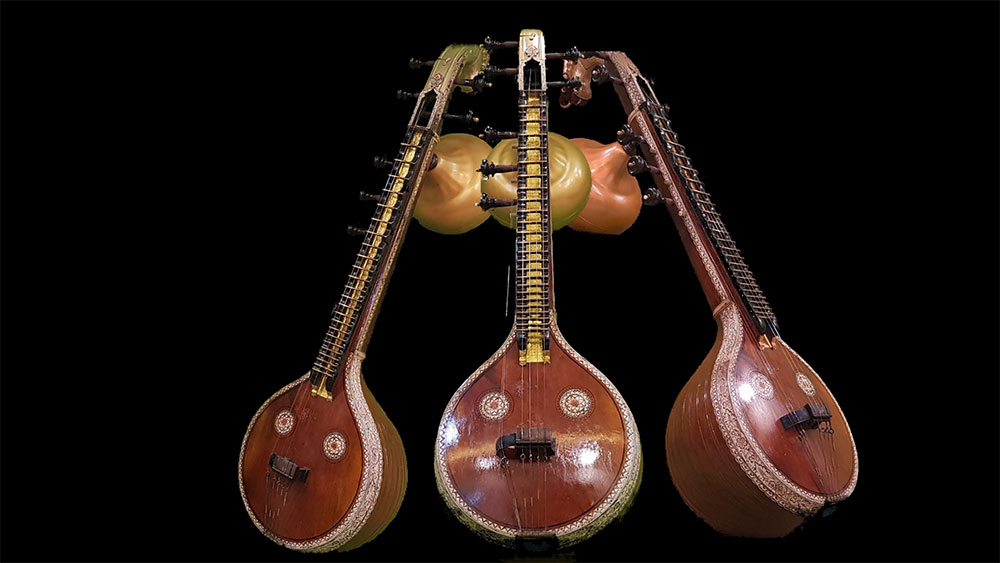
The Veena is a large and majestic string instrument. A beautifully carved resonator forms one end, connected to a long tubular wooden section known as the fret board. At the far right end is the Vyāli Mugam, a decorative wooden head traditionally carved in the shape of a dragon.
A secondary resonator—made of papier-mâché or fibre—is attached beneath the left portion of the fret board for support and balance. At the center of the top plank lies the bridge, over which the four main playing strings are stretched.
The fret board carries 24 brass frets arranged on two strips of specially prepared wax. Additionally, three thinner tāla (drone) strings run along the side of the fret board on separate pegs.
Fret Board
The fret board is the long tubular section that links the main resonator to the Vyāli Mugam. Measuring about 24 inches in length, it gradually tapers from left to right. The joints of this section are meticulously crafted and smoothed so that the entire structure appears to be carved from a single block of wood.
At the left end, there are four holes on either side to accommodate the main string pegs. At the centre front of the fret board are three additional holes for the drone (tāla) string pegs. Traditionally, the pegs are wooden—thicker outside and tapering inside—but modern Veenas sometimes use metal guitar-style pegs for greater tuning precision.
The four main strings vary in thickness and material:
- Sarani (first string) — steel, gauge 29 or 30
- Second string — steel, gauge 26 or 27
- Third and fourth strings — brass, gauges 22 and 20
These strings rest on the bridge at one end and the meru at the other. The tāla strings, typically gauges 31 and 32, rest on a curved metal support placed just in front of the bridge.
Recent innovations include fibre Veenas, travel-friendly dismantlable Veenas, Ekanda Veenas carved from a single block of wood, dual-resonator instruments, electronic Veenas, and the use of contact microphones and amplifiers for enhanced sound.
Veena-making remains a revered craft, sustained by master artisans primarily located in Tanjore, Bobbili, and Mysore. The rising demand for the Veena reflects a renewed appreciation for traditional art, craftsmanship, and culture.
Construction of the Veena
The crafting of a Veena is a meticulous and time-intensive process involving several stages.
Selection of Wood and Seasoning
Jackwood, mango wood, and rosewood are commonly used, with jackwood being the preferred choice due to its durability and tonal excellence. The wood is sourced from the stem portion of the tree, ideally five feet long and three and a half feet in diameter. A light brown tint signals maturity and suitability for scooping.
The different parts of the Veena are carved (or scooped) from this wood and then thoroughly seasoned. The main resonator, the largest component, requires several months of seasoning to ensure proper drying before assembly.
The top plank covering the resonator is about ¼ inch thick and contains two sets of breathing holes, each roughly one and a half inches wide.
The bridge, typically made from lighter wood, has a gentle arch and is about two inches high. It is securely fixed at the centre of the top plank. A slightly sloped metal plate is fitted on top to ensure smooth vibration of the main strings and optimal tonal clarity.
Conclusion
In recent years, Veenas made from fibre materials have begun to replace traditional wooden models, offering greater durability and lighter weight. Some modern Veenas can be dismantled and reassembled, making them convenient for travel. The Ekanda Veena, carved from a single block of wood, has gained popularity for its resonance and craftsmanship. Electronic Veenas, dual-resonator models, and the use of contact microphones and amplifiers have further expanded the instrument’s versatility and projection.
Yet, Veena-making remains a highly specialised art form. Master artisans in Tanjore, Bobbili, and Mysore continue to preserve this age-old craft with dedication and skill. The growing demand for these divine instruments is a heartening sign, reflecting a renewed appreciation for the cultural, artistic, and musical heritage embodied in the Saraswathi Veena.
Reference from – Veena by Dr. Raghavendra Rao and Dr. Jaishree Prasad