The Fret board
It is very important for Saraswathi veena students to know the layout of the Fret board, which is the main playing area. There are four main playing strings and three drone strings also called the tala strings.
The first main string closer to the player is called the Sarani and it holds the Madhya sthayi /middle octave and tara sthayi / upper octave.
The string next to it, holds 3 notes with variables of the Mantra Sthayi /lower octave, the entire middle octave and three notes of upper octave. The third string , like the sarani starts with a Shadjamam but that of the Mantra Sthayi and then a full Madhya Sthayi. The fourth string like the second , holds a bit of anu mantra sthayi, entire lower octave and a bit of the middle octave.
Octave
An octave comprises of the seven notes S.R,G,M,P,D and N.
- S – Shadjamam
- R – Rishabam
- G – Gandharam
- M- Madhyamam
- P- Panchamam
- D – Daivatham
- N – Nishadam
The Veena therefore consists of Anu-manthra Sthayi, Mantra Sthayi, Madya Sthayi , Tara Sthayi and one note of Athi-tara sthayi. With such a wide range of pitch presence the instrument is versatile and can easily be part of an orchestra and varied pitch play as an accompanying and solo instrument.
Playing postures
An instrument as large as the veena can be held in three positions. The slanting position which is used in North India for the sitar or the rudra veena is never used for the South Indian veena. However this position is widely shown in illustrations representing goddess Saraswati and also in the sculptures in ancient temples.
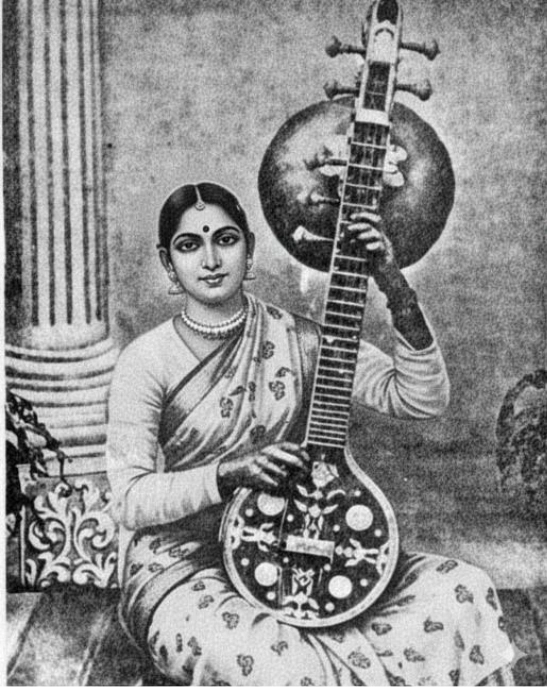
The vertical position known as “ Urdhva “, with the resonator balanced between crossed legs and the neck upright was still the norm in Andhra Pradesh at the turn of the century. It was also widely practiced in Mysore at the end of the 19th century and in all likelihood it was widespread in the other states as well in the middle of the last century.
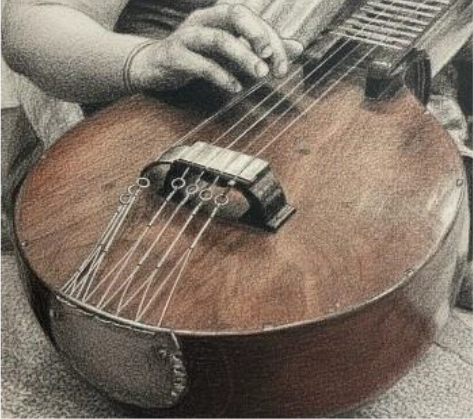
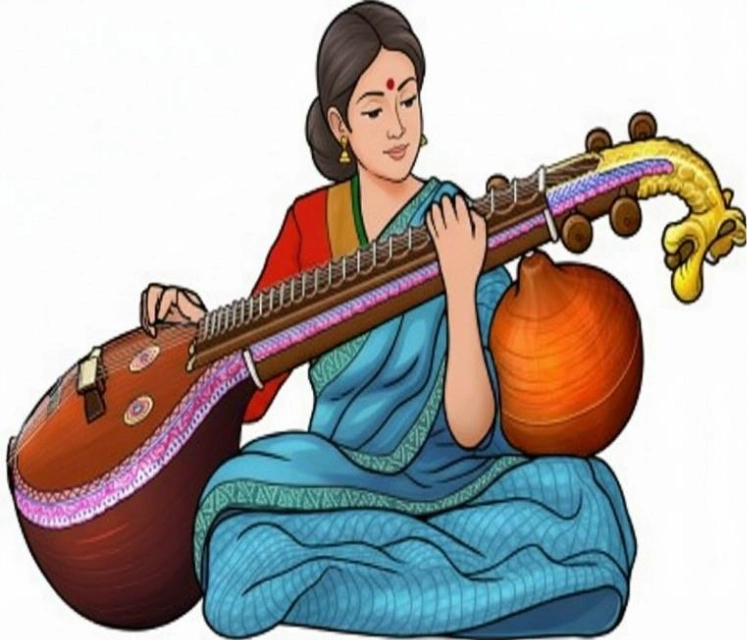
The horizontal position of the instrument, known as “ Sayana” is the only one that is actually practiced these days. The kudam/resonator, rests on the floor, to the right of the musician, and the neck is held in an almost horizontal position thanks to the gourd attached to it, which is placed on the left knee. The index and middle fingers of the left hand press the strings on the frets, while the right hand rests lightly on the edge of the resonator, plucking the strings with the index and the middle fingers, and the drone (tala) strings with the little finger. The veena is kept at an angle of degrees,facing the audience for good transmission of sound.
Sayana posture
Urdhva posture
Position of right hand on the veena