
The first and most significant thing a student has to learn is the tuning of the Veena. It is of utmost importance to have a finely tuned veena in the house for good energy. An untuned , unkempt and uncared for instrument is not good for theenergies of the place where it is kept. How do you tune the instrument?
First observe the body of the instrument well. There are four main playing strings that are named as follows :
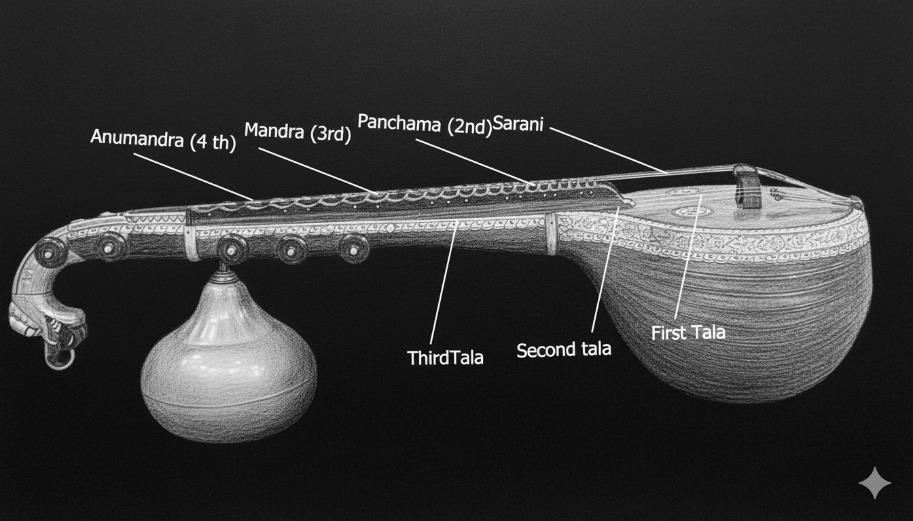
The first main playing string closer to the player is called the Sarini. When the student strikes this string the note that is produced is Shadjamam (S). What is Pitch in music ? Pitch is the frequency of sound and in this case while tuning the first string the sound/ note that you hear is S (Shadjamam). The Saraswathi Veena Shadjamam is closer to a male voice hence it can be tuned to pitches D, D# E or F. At pitch D and D# the string is loose enough and playing gamakams is well facilitated. E is a mid range tuning that helps to handle different styles of playing. At F the string is a bit tight and facilitates only certain type of genres.
Personally I prefer pitch E which in my experience helps play gamakams as well as fast paced songs. Tuning the veena requires a student to sharpen listening skills. The conventional way of tuning requires one to play the shruti box/app set to the desired pitch and keep listening and absorbing the sound carefully. As human beings our language skills have evolved through absorbing sounds. Hence sharpening that skill with a shruthi box is the best way to learning musical skills. The first string / Sarini is therefore set to Shadjamam. Today’s apps help students with a deflecting needle that points to the correct pitch. Though I am not against it , I would still suggest that one starts training one’s ears for tuning.
Important point to note while tuning
There are foure wooden/metal pegs corresponding to each string placed on both sides of the Yazhi mugam/dragon. Choose the correct one for the first string and turn it away from you to increase pitch and towards you to decrease. Always turn the pegs little at a time. If it is turned too much and too quick the strings might break. Show patience in turning the pegs. On the right hand side below the bridge are small metal rollers which are the Fine tuners. Push them down to increase and towards you to decrease for fine tuning.
Panchama string /2nd main string
This starts with the Mandra sthayi Panchamam. Using the Shadjamam, of the first string bring the open note of the second string to P. There is a secondary check you can do here. Match the 5th fret /note on the 2nd string with the S of the first string . They should sound the same, as this is the starting of Madhya Sthayi on the second string.
Mandra String / 3rd main string
This again is a Shadjamam but one octave lower to the first string. The entire arrangement of the third string is similar to the first string, except that it is physically thicker , sounds deep and holds the Mandra sthayi Shajamam as it’s pitching note. As a secondary check, go to the 7th fret/note of the third string which is panchamam and match it with the open note of the second string, or match the 12th fret/note on the third string to the open note of the first string which happens to be Madhya sthayi Shadjamam. Take time to chew this detail while trying to absorb the sounds.
Anumandra string / 4th main string farthest away from the student
This is similar in arrangement to the 2nd string with the open note being Panchamam, just that it is one full octave lower. Try to hear a P lower to the S of the third string here. A good secondary check is to play the 5th fret/note on the fourth string to hear it matching the open note of the third string. All of this takes time- to listen, absorb and execute.
Auxillary strings/talam
These are the three strings fixed to the front of the fret board and facing the student. Tune the top most string to Shadjama of the first string, the second to Panchamam or P of the first string and the lowest string to the shadjamam of the tara sthayi S. Once tuned strike each of them one by one to see if they are synchronised. If this exercise of tuning is followed daily one can achieve 75% skill for tuning in a month or earlier. Achieving 100% perfection is a Sadhana and requires passion and endurance.