
The earliest mention of the Saraswathi Veena comes in the Rig Veda as mentioned by the Sanskrit scholar Sȧyama who says ‘Dhamanto Vȧnam Marutaha meaning a special type of instrument played by the wind Gods which sounded like 100 veenas. Later scholars said what Sȧyama meant as veena , could have been the original lyre or the flute.
During the later stages of the Vedic period we find mention of various string instruments in the Brahmanas, Aranyakas, Upanishads and Sutras.
Brahmanas mentions 2 kinds of Veenas Deivi and Manushi Panchavimga Brahmana mentions the satatantri veena made of wood having a resonator with the skin of red ox and having ten strings made of munja grass.
In Aranyakas also Deivi and Manushi are mentioned but in a more detailed fashion. It says Deivi veena is the human body made by the Gods and Manushi veena is made of wood having similarities to the human body. Comparisons are made between the human body and the Veena ,one important feature being the head of humans to the resonator of the veena.
In Aithareya Aranyaka it is mentioned that priests played on the hundred stringed veena made of Audumbara wood.
In the Lȧtyȧyaniya Sutram names of various veenas are mentioned along with notes of where they should be played.
The Alabu veena , Vakra and Kapisisti were played on the eastern side of a mandap. The Mahaveena and the Pisheela were played in the interior. On the western side the secondary veenas like Kanda and Pichora veenas were played.
All of these literary works mention about the veena being played during religious ceremonies and yagnas.
A variety of string instruments are mentioned in the Ramayana and Mahabahrata.
In Ramayana, according to Valmiki the sons of Rama , Lava and Kusa were well versed in playing the veena. Ravana was known to be a great veena player.
Naradadiya Siksha, of the first century talks about two veenas namely, Dȧravi and Gȧtra similar to the Deivi and Manushi veenas, singing Samaganas.
The most important works on the performing arts in India is from Bharata”s Natya Shastra. According to him Gandharva is a musical performance, comprising of vocal music, veena and flute.
The veena is the main instrument in singing , dancing and as solo. Veena was used to show expression, were words are not needed,and also as bhavam for dance with no percussion.
Bharata mentions four types of veena. Vipanchi and Chitra veena seem to be instruments used in Drama,while Kachchapi and Ghosaka were secondary orchestra instruments. Chitra veena had seven strings, Vipanchi had nine. While chitra veena was played by plucking Vipanchi used a plectrum.
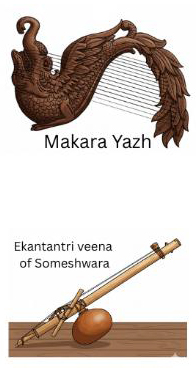
The earliest literary work in Tamil, namely Silappadikaram talks of Makara Yazh, Sagoda yazh,and Sengottu Yazh which are similar to a harp , but of different shape.
Someshwara the Chalukya king describes different types of veenas starting with Ekatantri veena. This veena has a hollow tube made of Khadira wood, and a single gourd with a string tied to the top of the tumba. There were no frets.
In the Lavanika Veena the danda is made of bamboo , the string from intestine of the goat, and a nabhi made of ivory. Frets are absent.
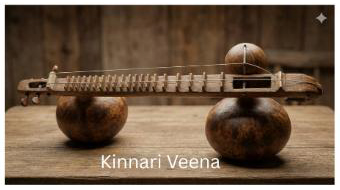
The 2 types of kinnari veenas that Someshwara describes are Laghvi and Brhati. While the former has two gourds , the latter has three.Laghvi kinnari has steel strings while Brhati had strings made of tendons. Fourteen frets made of wing bones of eagle were placed on bees wax dusted with cloth soot. The meru resembled an arrow.
Sangeeta Ratnakara of Sarangdev is a voluminous work on Music, Theories and musical instruments. He called the string instruments as tata vadhya which is played by plucking the string.
He mentiond two varieties of veena, the Swara Veena and the Sruti Veena. Sruti veena is like our tanpura helping in determination of 22 pitches. While the Swara Veena produced music.
Ramamatya a descendant of the Todarmal Family wrote the Swaramela Kalanidhi , which laid the foundation for Modern day Veena.He was the one who described the twenty melas with the help of the veena. He can be credited for the construction of a veena with four main strings and three talam strings pretty much a prototype to the modern day veena.
Venkatamukhi the author of Cahturdandi Prakasika, talks about different types of veenas Ekatantri, Dvitantri, Suddha mela veena, Madhya mela veena and Raghunatha mela veena a few of thenm similar to Ramamatyas descriptions. Venkatamukhi is more famous for his exhaustive work on the theories and practice of Carnatic music. There are many scultptures in various temples spread across the South of india, which give an idea about the evolution of veena over the years from unfretted to the fretted Veena of today.
Therefore it is interesting to note the journey of the Saraswati veena from Vedic Period till today , well documented by literature , sculptures and music.
Reference from – Veena by Dr. Raghavendra Rao and Dr. Jaishree Prasad